
• HOME
  • GETTING STARTED
    • Quick Start Guide
    • Evaluation Platform
    • Webinars 2026
    • Demo Videos
  • OUR PRODUCTS
    • All SimBio Modules
    • Textbook Replacements
      • SimBio Ecology
      • Intro Bio
    • Intro Bio
    • Ecology
    • Evolution
    • Cell Biology
    • Molecular Biology
  • DELIVERY SYSTEMS
  • PRICING & ORDERING
  • ABOUT
    • Overview
    • Employee Ownership
    • Research & Publications
    • Blog
    • Testimonials
    • Jobs
    • Accessibility
  • TECH SUPPORT
    • Support for Instructors
    • Support for Students

Mobile Menu

  • Menu
  • Skip to right header navigation
  • Skip to primary navigation
  • Skip to main content
  • Skip to primary sidebar
  • Skip to footer

SimBio logo

Simulated Biology. Real Learning.

  • Evaluation Platform
  • Contact
  • Blog
  • HOME
  • GETTING STARTED
    • Quick Start Guide
    • Evaluation Platform
    • Webinars 2026
    • Demo Videos
  • OUR PRODUCTS
    • All SimBio Modules
    • Textbook Replacements
      • SimBio Ecology
      • Intro Bio
    • Intro Bio
    • Ecology
    • Evolution
    • Cell Biology
    • Molecular Biology
  • DELIVERY SYSTEMS
  • PRICING & ORDERING
  • ABOUT
    • Overview
    • Employee Ownership
    • Research & Publications
    • Blog
    • Testimonials
    • Jobs
    • Accessibility
  • TECH SUPPORT
    • Support for Instructors
    • Support for Students

Ruling the Rock

Home » All Things SimBio » Ruling the Rock

July 1, 2026 //  by Eli Meir

On the 60th Anniversary of Keystone Species

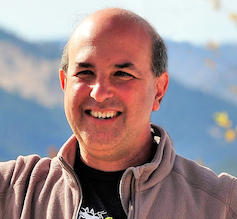
Eli MeirKeystone Predator, one of SimBio’s most popular ecology tutorial labs, allows students to experiment with the dynamic systems among the rocks in the intertidal zone. I was recently reminded of the relevance of Keystone Predator, as 2026 marks the 60-year anniversary of Food Web Complexity and Species Diversity, the seminal paper on which our tutorial is based.

When I authored Keystone Predator, I was sitting two doors down from the lab of the ecologist who wrote the paper, Dr. Robert Paine. In the early 1960’s, Paine periodically visited a stretch of rocky intertidal coastline near the University of Washington where he worked, picking up all the starfish and throwing them away from his study area. Simultaneously, a neighboring area was left alone. After just a year, it was clear that the community without starfish was changing to favor a single species that dominated space on the rocks. His groundbreaking paper covering this experiment led to several ideas that are now core to the ecological sciences, including keystone species, indirect effects, trophic cascades, and more. Just as importantly, his work showed the possibility of doing controlled field experiments to learn about ecological systems.

In learning about this story and the subsequent work from his students, I was intrigued by how simple the experiments were, and how an undergraduate could, conceptually, repeat Paine’s actions and make the discovery of keystone species for themselves.
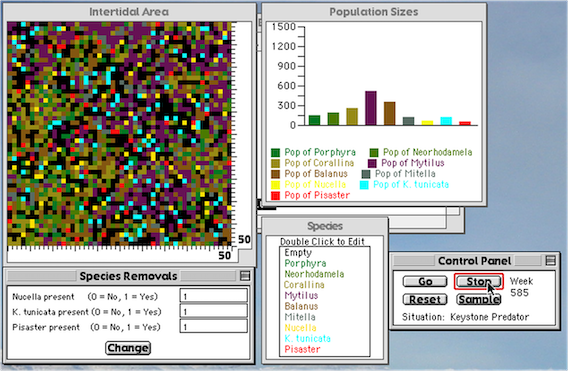
Using Paine’s work, I sought to replicate the experiment on a virtual level. The result, a nascent simulated environment called EcoBeaker, had the capacity to put different species on a virtual rock face and allowed other species to wander around eating them. Each individual appeared as a small colored square on the screen. Moving the mouse on the screen could clear areas of the rock or transplant species, allowing students to figure out where competition occurred. They could also measure what each species was eating and, with a click, follow Paine and remove the virtual starfish to observe the results. The data from Paine’s long-term experiment was available for students to collect in a typical class period, during which they could just about write their own version of Paine’s seminal paper.

Of course, for anyone who has gone tide pooling, clicking squares on a screen (even with the much fancier graphics we have nowadays) doesn’t compare to grabbing an actual starfish off a rock and turning it over, or seeing the fans of a barnacle moving in and out as they feed, and certainly doesn’t have the complexity of a true ecological system. But the conversations I had with Paine and his students about ecology are not all that different than the conversations I heard from students as they puzzled out their predictions of what will happen when they remove Pisaster in the Keystone Predator tutorial. Today, where critical thinking and skills like experimental design are among the most important learning students gain from a science education, it’s satisfying to see the simulation I built consulting with a master ecologist continuing to help students learn to think ecologically.

Author

  • Eli Meir
    Eli Meir

    SimBio founder Eli Meir brings together a PhD in biology, a long history of developing sophisticated software for both biology research and education markets, and over 20 years of experience running software companies. He has a passion for using these skills to improve education in both college and secondary schools through innovative products that let students learn by doing and playing.

    View all posts

Category: Biology Education, Research & CollaborationsTag: Active Learning, Student Assessment, Virtual Labs

Related Posts

Eli Meir

Harnessing Bad AI for Good Teaching

John Roach

SimBio Ecology – Comprehensive ecology education

Jaz Donkoh

In-class learning or homework?

John Roach

Risk, Insurance, & Climate Policy

John Roach

The hidden benefits of Ecology courses

Eli Meir

Study Confirms the Importance of Feedback

John Roach

Climate Change & Disease

John Roach

Icky Stories as Teachable Moments

Jaz Donkoh

Highlights from SABER

John Roach

Urban Ecology – Beyond Rock & Ice

John Roach

Tackling Climate Change

John Roach

Mysteries of the Sargasso Sea

Previous Post: «Eli Meir Harnessing Bad AI for Good Teaching

Footer

Testimonials

“[SimBio’s modules] provide a powerful environment for hands-on, active learning in Ecology and Evolution. The depth, design, and pedagogical effectiveness of these packages is unequaled. They have greatly enriched student interest and understanding in all of my courses, from Introductory Biology to Advanced Population Biology”

— Dr. Brad Lister
Rensselaer Polytechnic Institute

“The lab simulations have been very helpful to reinforce the lecture content and encourage students to use critical thinking skills to solve problems.”

— Patti Fallest-Strobl
Neumann University

“I was amazed how quickly and effortlessly the simulation taught them a dynamic system.”

— Paula Philbrick
University of Connecticut

“The students like [it] so much that they are working ahead of what I have assigned. They just think it’s fun. And from the quiz results I have so far, they’re really getting it. You guys are geniuses.”

— Paulette Bierzychudek
Lewis & Clark College

“Since we began using Simbio’s Ecology chapters our students consistently come to class better prepared. This is a key to the success of our hybrid flipped classroom approach.”

— Dr. Peter Curtis
Ohio State University

“That was the most fun I’ve had teaching ecology and, I would venture to guess, the most fun my students have had taking ecology from me.”

— Matt Orr
Oregon State University, Cascades

“Our students are more prepared and our class discussions are more sophisticated because SimUText is such a great out of class “instructor”. Since our students have SimUText preparation we can spend class time applying concepts and evaluating new information.”

— Emily Bernhardt
Duke University

“I LOVE that every lab is based on a real study. I LOVE that all of the labs offer an open-ended inquiry. I LOVE that the labs gradually teach the concepts and build up a repertoire of data collection techniques. Thank you, for creating them.”

— Jeanette Williams
Community College of Vermont

“I just wanted to say how great simutext has been. I could have memorized facts about the electron transport chain and passed the test, but would not have had any solid concept of what was happening inside. I hope that we continue to use it often even when things return to normal.”

— Student
Rochester Community and Technical College

“Congratulations for developing such a high quality chapter. I was very impressed by its comprehensiveness, accuracy, and thoughtful design. It really is superb.”

— Richard Boone
Humboldt State University

“I recommend your modules to anyone I can, because of all the online materials I’ve found, SimBio is really the best in content and best managed. I am definitely a SimBio fan!”

— Valerie Anderson
Marymount California University

All Things SimBio

  • Eli MeirRuling the Rock
    By Eli Meir
    July 1, 2026
  • Eli MeirHarnessing Bad AI for Good Teaching
    By Eli Meir
    June 16, 2026
  • John RoachSimBio Ecology – Comprehensive ecology education
    By John Roach
    June 1, 2026
More Blog Posts →

Contact

Shipping: 1280 S. Third St W., Missoula, MT 59801
Billing: P.O. Box 7158, Missoula, MT 59807
Phone: (833) 314-7701
Fax: (617) 279-0055
Questions?

SimBio Order Form
Privacy Policy
VPAT / Accessibility Statement

Site Footer

  • Facebook

Copyright © 2026 SimBio. All Rights Reserved. Trademarks.